


Page 62 - IAT
P. 62
promoting honesty, fairness, and accountability          and audit findings to stakeholders through
          among employees and stakeholders. Establishing a         transparent reporting channels.
          code of conduct and providing ethics training can help
          reinforce ethical behaviour across the organisation.     •  Encourage Stakeholder Engagement:
                                                                   Foster open communication and engagement
          •  Conduct Regular Risk Assessments: Conduct             with stakeholders, including shareholders,
          regular risk assessments  to  identify  and mitigate     employees, customers, and regulatory bodies.
          potential threats to the organisation’s objectives.      Solicit feedback, address concerns, and
          This involves identifying internal and external          incorporate  stakeholder  perspectives  into
          risks, evaluating their likelihood and impact, and       governance and audit processes to enhance
          developing risk mitigation strategies. Incorporate risk   transparency and accountability.
          management into governance and audit processes to
          ensure comprehensive risk oversight.                     Conclusion


          •  Enhance Board Oversight and Independence:             Internal auditing is a powerful tool for
          Strengthen board oversight and independence to           strengthening   corporate    governance    by
          improve governance effectiveness. This may involve       conducting audits to identify and evaluate
          appointing independent directors, establishing board     risks. These audits provide valuable insights
          committees with specific oversight responsibilities      into the processes and structures crucial for the
          (e.g., audit committee, risk committee), and             organisation’s success. As the complexity and
          conducting regular board evaluations to assess           volume of risks organisations face keep rising,
          performance and effectiveness.                           the role of internal audits is expected to broaden.
                                                                   This  includes  risk oversight, organisational
          • Implement Continuous Monitoring & Reporting:           culture and employee behaviour, sustainability
          Implement mechanisms for continuous monitoring           practices,  and    non-financial    reporting
          and reporting of governance and audit-related            metrics. In today’s environment with constant
          activities. This includes establishing key performance   technological   advancements,     geopolitical
          indicators (KPIs), metrics, and dashboards to            shifts, cyber security threats, and disruptive
          track  progress, identify  trends,  and facilitate  timely   innovations, a dynamic and adaptable internal
          decision-making. Regularly communicate governance        audit function becomes essential for ensuring
                                                                   sound corporate governance.


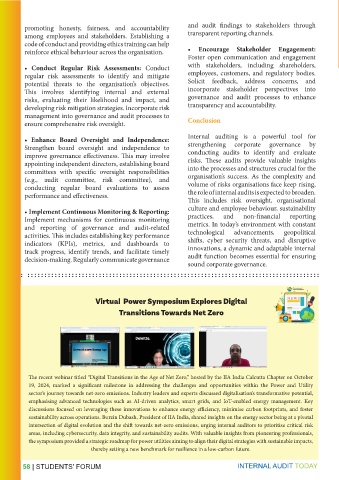
                                   Virtual  Power Symposium Explores Digital

                                           Transitions Towards Net Zero


           The recent webinar titled “Digital Transitions in the Age of Net Zero,” hosted by the IIA India Calcutta Chapter on October
           19,  2024, marked a  significant  milestone in  addressing  the  challenges  and opportunities  within  the  Power and  Utility
           sector’s journey towards net-zero emissions. Industry leaders and experts discussed digitalisation’s transformative potential,
           emphasising advanced technologies such as AI-driven analytics, smart grids, and IoT-enabled energy management. Key
           discussions focused on leveraging these innovations to enhance energy efficiency, minimise carbon footprints, and foster
           sustainability across operations. Burzin Dubash, President of IIA India, shared insights on the energy sector being at a pivotal
           intersection of digital evolution and the shift towards net-zero emissions, urging internal auditors to prioritise critical risk
           areas, including cybersecurity, data integrity, and sustainability audits. With valuable insights from pioneering professionals,
           the symposium provided a strategic roadmap for power utilities aiming to align their digital strategies with sustainable impacts,
                                 thereby setting a new benchmark for resilience in a low-carbon future.

          58 | STUDENTS' FORUM                                                      INTERNAL AUDIT TODAY

