


Page 64 - IAT
P. 64
Data Analytics: Your Secret


                               Weapon Against Risk!


          Srishti Sahni                                        •  Make  Data-Driven  Decisions:  Use  objective

          Global Risk Management Institute                     insights to prioritise risks and allocate resources
                                                               effectively.
                                                               • Predict and Prepare: Forecast future risks and
          In today’s fast-paced environment, organisations     develop contingency plans to minimise impact.
          encounter many risks, from financial uncertainties   This shift towards data-driven risk management
          to cyber threats, which can jeopardise their success.   promises a more secure and resilient future
          Traditionally, risk management has been reactive,    fororganisations across all industries.
          relying on instinct and past experiences. However,
          the transformative power of data analytics is
          ushering in a new era.

          Organisations can gain insights into potential risks
          by harnessing vast amounts of data. By analysing
          historical trends, identifying patterns, and building
          predictive models,  data analytics empowers
          organisations to:


          • Shift from Reactive to Proactive: Identify and
          mitigate risks before they strike.

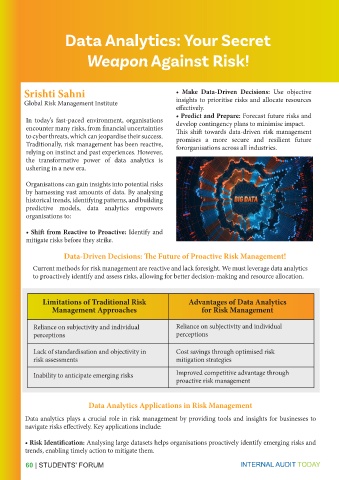
                       Data-Driven Decisions: The Future of Proactive Risk Management!

             Current methods for risk management are reactive and lack foresight. We must leverage data analytics
             to proactively identify and assess risks, allowing for better decision-making and resource allocation.


                Limitations of Traditional Risk                    Advantages of Data Analytics
                   Management Approaches                                for Risk Management


             Reliance on subjectivity and individual           Reliance on subjectivity and individual
             perceptions                                       perceptions


             Lack of standardisation and objectivity in        Cost savings through optimised risk
             risk assessments                                  mitigation strategies

             Inability to anticipate emerging risks            Improved competitive advantage through
                                                               proactive risk management


                                Data Analytics Applications in Risk Management

          Data analytics plays a crucial role in risk management by providing tools and insights for businesses to
          navigate risks effectively. Key applications include:


          • Risk Identification: Analysing large datasets helps organisations proactively identify emerging risks and
          trends, enabling timely action to mitigate them.

           60 | STUDENTS' FORUM                                                      INTERNAL AUDIT TODAY

