


Page 65 - IAT
P. 65
• Risk Assessment and Prioritisation: Advanced techniques like machine learning assess the likelihood
          and impact of threats, allowing businesses to prioritise risks based on their potential effects on operations.

          • Scenario Modeling: Data analytics enables the creation of models that simulate various risk scenarios,
          helping organisations understand potential outcomes and develop effective mitigation strategies.

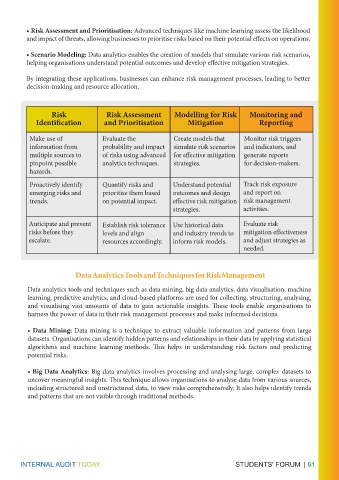
          By integrating these applications, businesses can enhance risk management processes, leading to better
          decision-making and resource allocation.


                   Risk               Risk Assessment         Modelling for Risk         Monitoring and
              Identification          and Prioritisation           Mitigation               Reporting

           Make use of               Evaluate the             Create models that       Monitor risk triggers
           information from          probability and impact   simulate risk scenarios   and indicators, and
           multiple sources to       of risks using advanced  for effective mitigation   generate reports
           pinpoint possible         analytics techniques.    strategies.              for decision-makers.
           hazards.


           Proactively identify      Quantify risks and       Understand potential    Track risk exposure
           emerging risks and        prioritise them based    outcomes and design     and report on
           trends.                   on potential impact.     effective risk mitigation  risk management
                                                              strategies.             activities.

           Anticipate and prevent    Establish risk tolerance  Use historical data    Evaluate risk
           risks before they         levels and align         and industry trends to   mitigation effectiveness
           escalate.                 resources accordingly.   inform risk models.     and adjust strategies as
                                                                                      needed.


                            Data Analytics Tools and Techniques for Risk Management

           Data analytics tools and techniques such as data mining, big data analytics, data visualisation, machine
           learning, predictive analytics, and cloud-based platforms are used for collecting, structuring, analysing,
           and visualising  vast amounts  of data to  gain  actionable  insights. These  tools  enable organisations to
           harness the power of data in their risk management processes and make informed decisions.

           • Data Mining: Data mining is a technique to extract valuable information and patterns from large
           datasets. Organisations can identify hidden patterns and relationships in their data by applying statistical
           algorithms and machine  learning  methods.  This helps  in understanding  risk factors and predicting
           potential risks.

           • Big Data Analytics: Big data analytics involves processing and analysing large, complex datasets to
           uncover meaningful insights. This technique allows organisations to analyse data from various sources,
           including structured and unstructured data, to view risks comprehensively. It also helps identify trends
           and patterns that are not visible through traditional methods.


        INTERNAL AUDIT TODAY                                                         STUDENTS' FORUM  | 61

