


Page 67 - IAT
P. 67
participate in risk management. These advancements enable organisations to proactively identify and
          mitigate risks, improving decision-making, operational efficiency, and competitive advantage in a data-
          driven world.


                         Advancements                                 Emerging Technologies

            Integration of AI and ML algorithms               Blockchain

            Real-time data analysis and prediction            Internet of Things (IoT)


            Improved risk management practices                Cloud computing

            Accessibility and user-friendly interfaces


                       Overcoming Challenges in Data Analytics for Risk Management

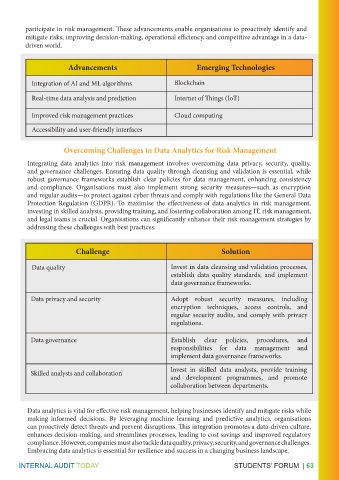
           Integrating data analytics into risk management involves overcoming data privacy, security, quality,
           and governance challenges. Ensuring data quality through cleansing and validation is essential, while
           robust governance  frameworks  establish clear  policies  for data management, enhancing  consistency
           and compliance. Organisations must also implement strong security measures—such as encryption
           and regular audits—to protect against cyber threats and comply with regulations like the General Data
           Protection Regulation (GDPR).  To maximise  the effectiveness of  data analytics  in risk management,
           investing in skilled analysts, providing training, and fostering collaboration among IT, risk management,
           and legal teams is crucial. Organisations can significantly enhance their risk management strategies by
           addressing these challenges with best practices.


                            Challenge                                          Solution


            Data quality                                     Invest in data cleansing and validation processes,
                                                             establish data quality standards, and implement
                                                             data governance frameworks.

            Data privacy and security                        Adopt robust  security measures,  including
                                                             encryption techniques, access controls, and
                                                             regular security audits, and comply with privacy
                                                             regulations.


            Data governance                                  Establish   clear  policies,  procedures,   and
                                                             responsibilities for data management and
                                                             implement data governance frameworks.


            Skilled analysts and collaboration               Invest in skilled data analysts, provide training
                                                             and development programmes, and promote
                                                             collaboration between departments.


           Data analytics is vital for effective risk management, helping businesses identify and mitigate risks while
           making  informed  decisions.  By  leveraging  machine  learning  and  predictive  analytics,  organisations
           can proactively detect threats and prevent disruptions. This integration promotes a data-driven culture,
           enhances decision-making, and streamlines processes, leading to cost savings and improved regulatory
           compliance. However, companies must also tackle data quality, privacy, security, and governance challenges.
           Embracing data analytics is essential for resilience and success in a changing business landscape.

        INTERNAL AUDIT TODAY                                                        STUDENTS' FORUM  | 63

