


Page 60 - IAT
P. 60
risk owners, and internal audit, all working together    Learnings:
          to achieve organisational objectives while effectively    • The different mechanisms (internal
          managing risks.                                           and external) that influence a company’s

          Why Corporate Governance is                               behaviour and decision-making.
          Important:                                                •  The roles and responsibilities of various
                                                                    stakeholders involved in corporate governance
          •  Reduced Risk and Increased Transparency: Good          (board, management, shareholders, internal
          governance helps identify and manage potential            audit).
          risks derailing company goals. It also ensures clear      •   How to identify and manage risks through
          communication between different parties (board,           effective risk management strategies.
          management, shareholders) about these risks and           • The importance of internal controls and
          how they are addressed.                                   clear communication in ensuring smooth
          •  Ethical Operation and Public Trust: Effective          operations.
          corporate governance promotes ethical behaviour           •   How a well-functioning governance system
          within the company. This fosters trust with the public    fosters a culture of ethics and compliance.
          and other stakeholders, essential for a company’s
          long-term success.                                        Understanding these corporate governance
          •  Achieving Goals and Objectives: By  setting  a         aspects equips you to evaluate companies
          clear direction and holding everyone accountable,         and their long-term prospects better. It
          good governance helps organisations achieve their         also helps you grasp the inner workings
          strategic objectives.                                     of organisations and how different parties
                                                                    collaborate to achieve success.


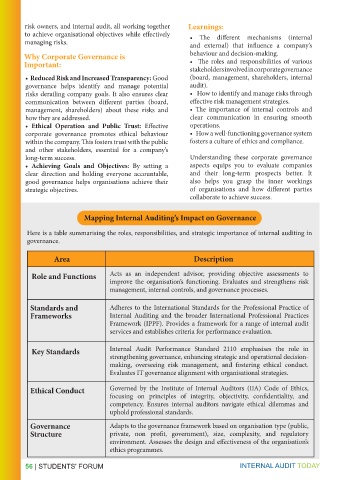
                               Mapping Internal Auditing’s Impact on Governance


           Here is a table summarising the roles, responsibilities, and strategic importance of internal auditing in
           governance.


                    Area                                             Description

            Role and Functions          Acts as an independent advisor, providing objective assessments to
                                        improve  the  organisation’s  functioning.  Evaluates  and  strengthens  risk
                                        management, internal controls, and governance processes.


            Standards and               Adheres to the International Standards for the Professional Practice of
            Frameworks                  Internal Auditing and the broader International Professional Practices
                                        Framework (IPPF). Provides a framework for a range of internal audit
                                        services and establishes criteria for performance evaluation.


            Key Standards               Internal Audit Performance Standard 2110 emphasises the role in
                                        strengthening governance, enhancing strategic and operational decision-
                                        making, overseeing risk management, and fostering ethical conduct.
                                        Evaluates IT governance alignment with organisational strategies.

            Ethical Conduct             Governed by the Institute of Internal Auditors (IIA) Code of Ethics,
                                        focusing on principles of integrity, objectivity, confidentiality, and
                                        competency. Ensures internal auditors navigate ethical dilemmas and
                                        uphold professional standards.

            Governance                  Adapts to the governance framework based on organisation type (public,
            Structure                   private, non profit, government), size, complexity, and regulatory
                                        environment. Assesses the design and effectiveness of the organisation’s
                                        ethics programmes.

           56 | STUDENTS' FORUM                                                      INTERNAL AUDIT TODAY

